


Freshly-cooked lemang, or sticky rice cooked in bamboo, cooling on a fresh banana leaf
After my parents left last week, I jumped right into another daylong activity with my favorite local chef-teacher, Chef Rash. Our class was held outside of the city this time, in a part of jungle just past the National Zoo called Hulu Kemensah. While we prepared a variety of dishes, the focus of the day was on making lemang, a coconut sticky rice wrapped in banana leaves and cooked in a hollow bamboo husk over a charcoal fire. Sound complicated? Well, it is, so much so that lemang is typically only eaten during Malaysian Ramadan, the Muslim month-long holiday of fasting (or, as it seems in Malaysia, fasting followed by a period of indulgent gorging in a wide variety of foods as soon as the sun goes down).
Anyway, during Ramadan last year and only about a month after I’d moved to KL, I went on a day tour of Sri Mananti Palace on the outskirts of the city. Honestly, the palace didn’t leave much of an impression on me, but as part of the tour we stopped for lunch at a Malaysian lady’s home. She’d spent days preparing a traditional Ramadan feast for us to sample. One of the things she’d prepared was a beef rendang (kind of a thick beef curry) and lemang, and to this day I find myself daydreaming about that dish whenever Giuliana and Bill on E! is a rerun. In my defense, I only watch that show when there’s nothing else on, okay?
Needless to say, I was pretty excited to try my hand at making my own lemang.

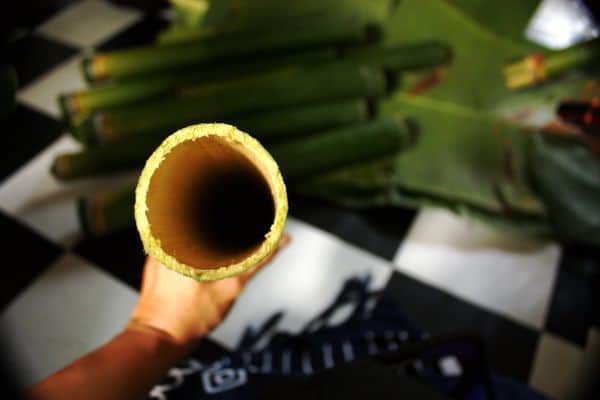
Bamboo stalks must be wide enough to hold a banana leaf, sticky rice, and coconut milk
For lemang, three hard-to-obtain ingredients are key: wide bamboo stalks, older banana leaves, and young banana leaves. Locally, older banana leaves are pretty easy to come by; most markets in town sell a bundle for about 3 ringgit ($1 USD) or so. But when my friends and I pressed Chef Rash on where we could procure bamboo stalks and young banana leaves, his cryptic response was, “You have to find a jungle person to cut them for you.” Unfortunately, my friend roster here in KL doesn’t yet include a jungle person, but whenever I make that vital connection, trust that I will shout that glorious news from the rooftops.
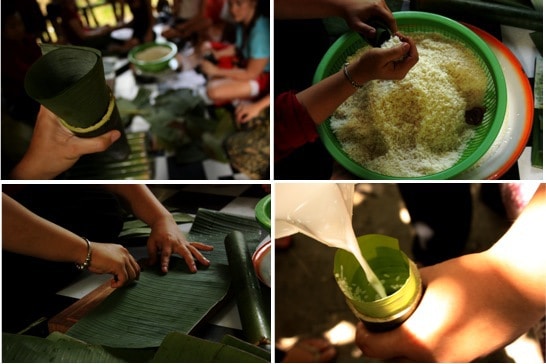
Top left: rolling the banana leaves and inserting them into the bamboo requires patience and a steady hand; bottom left: preparing a new bamboo leaf for rolling; top right: pouring in uncooked sticky rice; bottom right: adding salted coconut milk
vKnowing that the odds were slim that we could ever reproduce lemang in the comfort of our own kitchens, my friends and I set about making a lot of it so we’d have extra to take home and prolong the sticky rice. Every part of the banana leaf is used in the process — the old leaves are separated from their stems, which are used to help mold the young banana leaves into a tight enough roll to be inserted into the bamboo. The old leaves are then later reused to hold the cooked lemang. After a roll of young banana leaf lines the inside of each bamboo stalk, glutinous (sticky) rice that’s been soaking overnight gets poured into the bamboo stalk, handful by handful. To top it off, salted fresh coconut milk is poured into the stalk, which is what cooks the rice to sticky, coconut-y perfection.
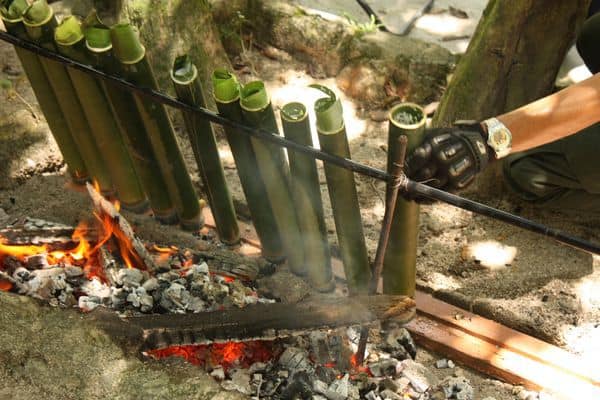
After the bamboo stalks are filled with rice and coconut milk, over an open fire they go
The other difficult aspect of making lemang is that it requires a fire maintained at just the right temperature, and the bamboo stalks have to be rotated and watched constantly so that each side gets cooked evenly and doesn’t scald. Plus, it can take up to eight hours for the lemang to fully cook. Eight. That basically means sacrificing a workday, or, in my case, a Golden Girls marathon, to literally watch rice cook.
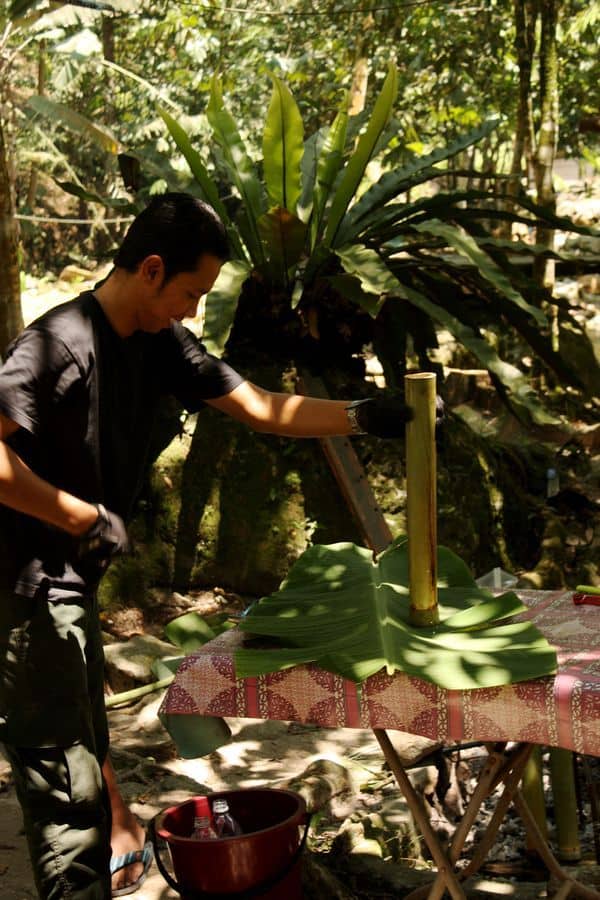
After removing the lemang from the fire, it’s time to split the bamboo open — with a machete
When the rice has fully absorbed all the coconut milk and is translucent, the lemang is ready to serve. The bamboo stalks are removed from the fire and sliced open. With a machete. Now, I’m a lover of kitchen gadgets, and Lord knows we have a pile of them sitting around in drawers that we never use, but I think I could justify adding a machete to my kitchen arsenal. How else am I expected to open a coconut, or, in this case, remove lemang from its bamboo stalk?
The best part of the whole process, of course, is the eating. The rice is naturally slightly sweet, even more so from the coconut milk. With a healthy dose of salt added to the coconut milk before cooking, the rice takes on just the right amount of saltiness, too. I ate my lemang by the spoonful, then by the handful (utensils can get in the way sometimes), but we also paired it with beef rendang, grilled chicken and sting ray. I took some lemang home in a Tupperware, too, so that this time, I can keep up with those crazy kids on E! and eat my sticky rice, too.


You’re welcome! It was eye-opening for me, too!
Fantastic stuff. I often buy lemang to eat but your post is an eye-opener on how they make the stuff. Thanks so much for sharing.