


A Chow Kit vendor calls out her wares to a customer as she hands him his daily haul
Kuala Lumpur and I have gotten to know each other pretty well over the last few months, but every once in while I’m reminded that there are entire swaths of city that are still unknown to me. Up until last week, one of those places was Chow Kit, an open-air market in town primarily catering to Malaysians. I’ve fallen comfortably into a routine of alternately frequenting Western-style grocery stores, the pasar (market) at Taman Tun Dr. Ismail and my favorite Chinese open-air market just off Jalan Imbi for our weekly groceries, so I haven’t really seen the need to add a fourth market to my list of weekly stops. Besides, I’d heard things about Chow Kit that set it apart from the other markets in town, namely that it’s hectic, noisy, crowded and there’s water filled with chicken blood being splashed about.
Regardless of my prior feelings about the place, I finally braved Chow Kit in the company of four of my friends and our chef-teacher Rash for a trip to pick up ingredients for our street food cooking class. After we finished our shopping at Chow Kit, where we learned how to pick the freshest local ingredients, we headed back to the kitchen to learn four types of popular Malaysian street hawker noodles: mee mamak, char kuey teow, assam laksa, and mee rebus.
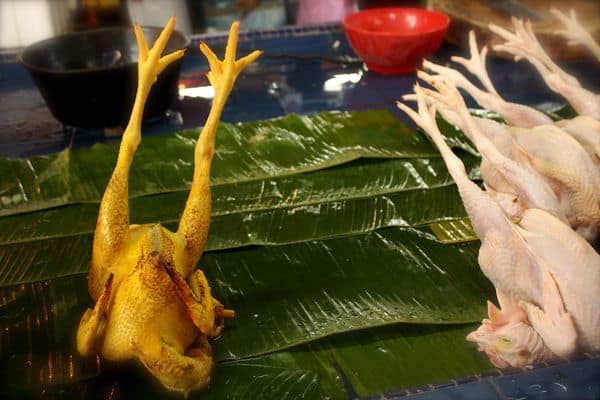 Weirdly, I started humming a “One” from A Chorus Line in my head when I saw these chickens
It turns out Chow Kit is pretty much like any other large open-air market in town, except that it’s much larger than the ones I normally frequent. The market also has a bountiful supply of Malaysian ingredients, such as banana leaves, pandan (a stiff green leaf commonly used to flavor all sorts of Malaysian dishes); tempeh (a fermented soybean cake) and, most importantly, blood cockles. I’ve eaten many blood cockles here, mainly in one of my all-time favorite Malaysian dishes, a stir-fried flat rice noodle dish called char kuey teow.
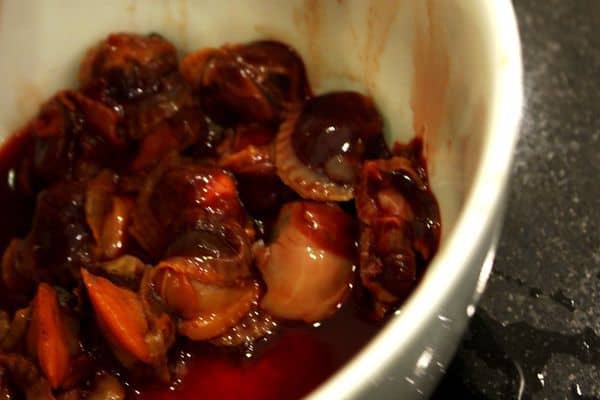
Above: blanched cockle meat; below: the separated shells show the cockles’ true colors
Blood cockles, I’ve learned, aren’t the most beautiful mollusk to wash and prepare; I felt like I was doing something horrendously violent as I shelled them and their deep red liquid came pouring out. Sorry, cockle friends. I can’t help that you’re so delicious and briny.
In addition to bathing my hands in a river of cockle blood, I also discovered that I still have a lot to learn about Malaysian street food. After months of eating in all sorts of hawker establishments, I’ve found that tasting the foods only gets you so far in understanding and appreciating the flavors and work that goes into their preparation. While mee mamak, a basic stir-fried noodle, carried few surprises other than a healthy dash of curry powder, making mee rebus showed me I don’t know nothing about no street noodles. I’ve had mee rebus before (it’s a soupy noodle dish with a thick orange-yellow sauce), and I’ve always assumed that the sauce was a curry-based daal (lentil). It turns out I was completely off-base; it’s actually a combination of sweet potato and dried shrimp. As for the assam laksa, a noodle soup with a tamarind and fish based broth, we learned how to clean and gut blue mackerel, then parboiled them with tamarind pods, which were then reused to flavor the broth as well.
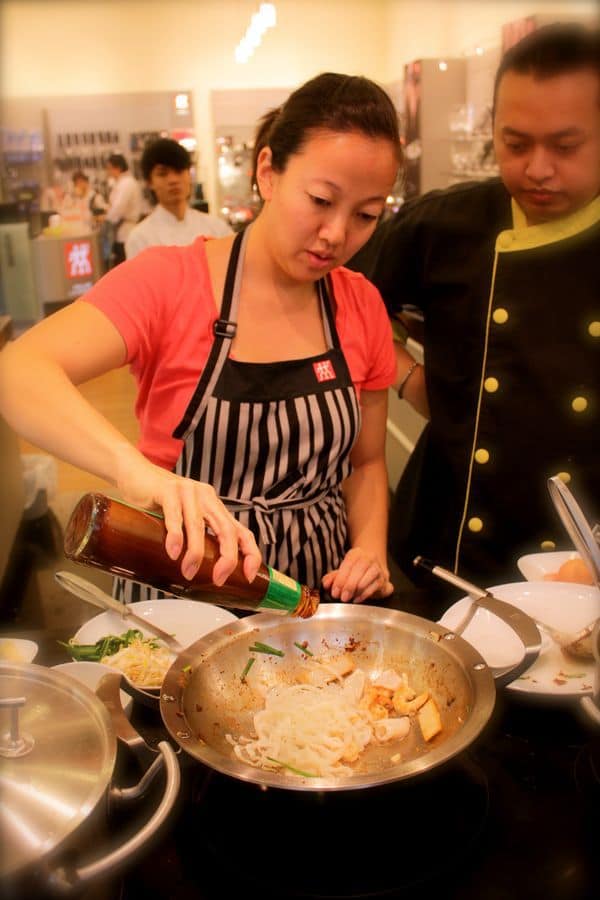
I gingerly dribble oyster sauce into my char kuey teow; how much, according to our teacher, is completely done by feel
And then, of course, there was my beloved char kuey teow. In addition to shelling blood cockles, char kuey teow requires a knowledge of how to pick fresh rice noodles and clean squid, two skills which I sorely lacked until now. We each stir-fried our own portion of noodles, which also included Chinese chives, fish cake, bean sprouts and shrimp. When we finally sat down to taste the spoils of our hard work — oh me oh my, was it ever so tasty. Still, Chef Rash informed us that without the wok hei (the smoke and char from a well-seasoned cast iron wok), our versions of char kuey teow just weren’t the same, and I could see that, sure. But all that means is that I have just over a year to get my wok good and charred, just in time to open my own little mamak stall when we return home to the US.
Chow Kit Market | Open daily from 8:00 am-ish to 5:00 pm | At the northern end of Jalan Tuanku Abdul Rahman
Information on Chef Rash and his delightful classes can be found here.


Ann- I see the Henckels logo and it brings me back to my quest for new knives. The Pro S sets come with a hollow or a regular 8″ chef knife. What are the advantages and disadvatages of each? Please share any thoughts.
We actually don’t have Henckels knives even though I take classes from Chef Rash, who’s employed by them. My first big purchase after I started working as a lawyer were to get two Wustof knives, an 8″ chef’s knife and a hollow/Santoku knife. My preference is for the chef’s knife — I find it easier to use, even though the hollow knife is supposed to be better for getting a clean cut of hard vegetables. Also, everything I’ve read is that you shouldn’t buy a set, but rather buy things piece by piece, because the sets often come with knives you’ll never use. We’ve stuck to that philosophy and added knives over the years (along with our wedding registry) that supplement those two first basic knives I bought. Now we’re total Shun addicts — it’s a Japanese brand available through Williams-Sonoma. Hope this helps!
GET ALL THE LATEST RECIPES, RESTAURANT REVIEWS & MORE FROM GRITS &
http://www.rsdesign.com.my